This was originally published on my Substack, Spoilers Ahead! You can read it there. It could use the views. But Substack in my experience has been a bit of wasteland, the problem being that unless a Substack meets very specific criteria, it does not get indexed by Google and therefore is extremely hard to find. As this post contains a number of statements that are both true (I think) and not widely known, I wanted to give it a bit more exposure.
I’ve been thinking about Atlantis quite a bit lately, partly because I just read Francis Stevens’ novel Claimed! (1920), and quite enjoyed it. You can see how Lovecraft mined bits of it for his personal mythos —evil, godlike beings from ancient, sunken realms, for example. I’ll probably write more about Claimed! at a later date.
But what caught my immediate attention were some the plot particulars: a man comes into possession of a relic found in the ruins of Atlantis, and the King of Atlantis, none other than the God Poseidon himself, shows up to get it back.
And it occurred to me at this point that I was seeing a lot of references to Atlantis in my daily reading. For example, it is suggested that the underground world in A. Merrit’s The Moon Pool is really Mu or Lemuria, which is a kind of Atlantis of the Pacific. It is hinted that the warring tribes in his The Face in the Abyss are escapees from Atlantis itself, and their city is called Yu-Atlanchi, which I am sure is supposed to translate as “New Atlantis”.
But of course I’ve been reading lots of lost world novels, so perhaps I shouldn’t have been surprised that the prototypical lost world is mentioned in their pages.
Also, back in the summer I found a copy of Godfrey Higgin’s Anacalypsis Book 2 at a Value Village, and have been leafing through it ever since. Published in 1836, The Anacalypsis is notable for a couple of things. The first is its size, which is humongous. Book II looks like an Eaton’s catalogue (if you remember those), and there is a Book I to go along with it1. The second notable thing is its overarching thesis: all modern languages are derived from the language of Atlantis, this being a kind of Proto-Hebrew. And after Atlantis sank, its colonies on both sides of the ocean went their own way, slowly developing into the various tribes of men that we see today, speaking their divergent languages.
I am not sure quite how to classify the book. Were it published in 2025 it would be considered Pseudo- or Alt-History. For example, the assertion that the Anglo Saxon invaders of England spoke Hebrew has not held up to historical scrutiny, to put it mildly. However, when it was written Higgin’s was considered a legitimate historian, as far as I can tell, and the overall state of knowledge back then may have made his claims seem more reasonable. My favorite authority on these things, Jason Colavito, uses the term “obsolete” to describe The Anacalypsis, which seems a nice way of putting it.
But what is clear is that Steven’s description in Claimed! matches the one put forth in Higgin’s vast tome, down to an inscription on the Atlantean artifact being written in a primitive form of Hebrew. However, it is unlikely Stevens based her account on a book with scholarly pretensions. She was probably using Ignatius Donnelly’s Atlantis: The Antediluvian World (1882).2 Donnelly’s book was a popularization of the work of Higgin’s and others, and became enormously popular in its time. Its influence has continued into the present, with for example Alt-Historian Graham Hancock calling it the inspiration behind his theories of human prehistory as presented in the Netflix series Ancient Apocalypse.
And here is where we finally get to the point of this post. Because when I dug into Donnelly’s work, I found that his views had been significantly distorted, by both Graham Hancock and more reputable sources.
But I suppose I should back up a bit: who was Ignatius Donnelly, and what was he on about?
*Ignatius Donnelly was an American Congressman and popular writer. He entertained a number of odd theories, including the idea that Francis Bacon wrote Shakespeare’s plays. In his best known work, Atlantis: The Antediluvian World (1882), he argued that Atlantis was a real place and in fact the cradle of civilization, spawning all the world’s major religions and languages before disappearing beneath the waves at some point in ancient history.
A year later he published a second book, Ragnarök: The Age of Fire and Gravel. While less popular, it has proven even more influential. Again, fringy types like Hancock have referenced it. In particular Hancock has claimed that the ideas presented there are an early formulation of the Younger Dryas Impact Hypothesis (YDIH). which plays a central role in his own theories of mankind’s past. Because in Ragnarök, Donnelly argued that the planet was struck (or perhaps merely brushed) by a comet, causing wide-spread devastation and indeed the fall of man, at least such men as were living around the Atlantic basin at the time. And indeed this account does bear some superficial resemblance to the key tenets of YDIH, which postulates an impact with disastrous consequences about 12-13,000 years ago.
However, the way Ragnarök appears in popular discourse misrepresents its contents on two important matters.
*The Fate Of Atlantis
The first error is illustrated by this version of the book’s cover:
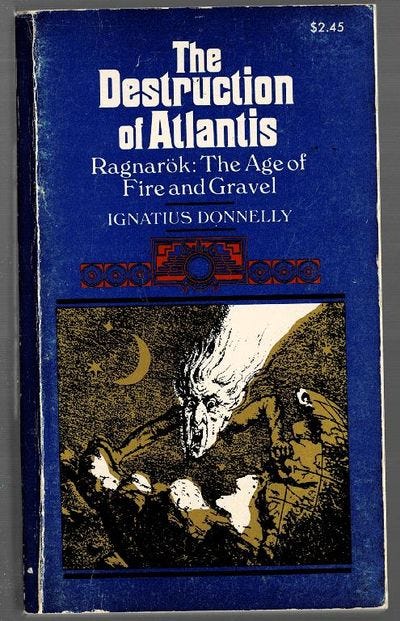
The original and correct title is Ragnarök: The Age of Fire and Gravel (1883). There is no reference to Atlantis in it. As noted, Atlantis: The Antediluvian World came out the year previous, but there are no refences to Ragnarök in that earlier book (although it does contain a few off-the-cuff references to comet impacts).
And this volume is clearly not a repackaging of the two publications. Its biblio description says it is 452 pages in length, which matches Ragnarök but is a bit short of Atlantis’ 480 pages. It is clearly much shorter than any combination of the two. So the book is just the text of Ragnarök, with the publisher (Steiner Books, 1971) amending its title. And there are other versions of the book that use the same altered title, though their cover design is different from what you see above.
But the thing is, Donnelly clearly states that Atlantis survived what he calls The Drift: the result of that cometary encounter that rained flaming gravel down on the planet’s surface3. He writes:
It was the great land of the world before the Drift; it continued to be the great land of the world between the Drift and the Deluge. (P.388)
Elsewhere, he is even more specific:
In short, we may say that, wherever any of these legends refer to the locality where the disaster came and where man survived, the scene is placed upon an island, in the ocean, in the midst of the waters; and this island, wherever the points of the compass are indicated, lies to the west of Europe and to the east of America: it is, therefore, in the Atlantic Ocean; and the island, we shall see, is connected with these continents by long bridges or ridges of land.
This island was Atlantis. (P. 376)
So Atlantis served as a refuge from The Drift, and in its aftermath men from that place renewed civilization. They went forth over its land bridges and:
…from this center, in the course of ages… spread east and west, until they reached the plains of Asia and the islands of the Pacific. (P.366)
It is interesting that Pre-Drift Atlantis was something more like a chain of islands:
…they were the pathways over which the migrations of races extended in the ancient days; they wound for thousands of miles, irregular, rocky, wave-washed, through the great ocean, here expanding into islands, here reduced to a narrow strip, or sinking into the sea; they reached from a central civilized land--an ancient, long-settled land, the land of the godlike race--to its colonies, or connections, north, south, east, and west; and they impressed themselves vividly on the imagination and the traditions of mankind, leaving their image even in the religions of the world unto this day. (p394)
But after The Drift occurred the oceans receded, exposing submerged land. Atlantis became a solid mass with plains and mountains, the version seen in The Antediluvian World. It was only long afterwards that a second cataclysm called The Deluge sank it for good.
Note that, given the date of the Steiner publication, this mis-representation doesn’t originate with Hancock, But he goes with it, rolling the two cataclysms into one, perhaps for aesthetic effect: perhaps the story seems somehow “neater” this way. Or maybe he didn’t read the book.
*The Date The Comet Struck
If you go to Ragnarök’s page on Wikipedia it says:
In Ragnarök, Donnelly argues that an enormous comet hit the earth 12,000 years ago….
And this claim is recycled by both Hancock and his critics. But I have searched several different on-line versions up, down, and sideways after reading the whole thing through and I cannot find any place where Donnelly makes this claim.
However, I was able to find the following quote which sets Ragnarök/The Drift much earlier in time:
Is it not more reasonable to suppose that civilized man existed on the American Continent thirty thousand years ago, (the age fixed by geologists for the coming of the Drift) (P.355)
And in the book’s Q&A, Donnelly gives dates to both The Drift and The Deluge of Noah. Here too, The Drift occurs much, much earlier:
“What relation, in order of time, do you suppose the Drift Age to hold to the Deluge of Noah and Deucalion? “
The latter was infinitely later. The geologists, as I have shown, suppose the Drift to have come upon the earth--basing their calculations upon the recession of the Falls of Niagara--about thirty thousand years ago. We have seen that this would nearly accord with the time given in Job, when he speaks of the position of certain constellations. The Deluge of Noah probably occurred somewhere from eight to eleven thousand years ago. Hence, about twenty thousand years probably intervened between the Drift and the Deluge. These were the “myriads of years” referred toby Plato, during which mankind dwelt on the great plain of Atlantis. (P.404)
So I don’t know where the 12,000 YBP claim comes from, but I am sure it isn’t Donnelly. And it is interesting that Donnelly’s real views make him less useful to the Alt-History project, which in its most recent form posits a comet strike destroying Atlantis around that time. I wonder if we’re looking a some kind of deliberate mis-reading that has become the conventional wisdom because nobody has bothered to read the book in years?
*My apologies for writing something this unfocused, but Atlantis bridges two of my interests--old genre fiction and modern pseudo-science—in a way that seems to generate thoughts, if somewhat disconnected ones. So there will probably be a part II.
Back in the 19th century they didn’t have TV or The Internet, so they wrote (and read) very long books.
For example, both she and Donnelley reference the Challenger expedition, which mapped Earth’s oceans in unprecedented detail during the 1870s.
No comments:
Post a Comment