Showing posts with label Blanding`s Turtle. Show all posts

Tuesday, April 21, 2015

Ostrander Point Wind-Farm Case Goes Back To Tribunal

The decision is here.  Put briefly, the case will now get bounced back down to the Ontario ERT, where Ostrander Point Wind Energy will have a chance to convince the tribunal that their proposed remedy, a series of fences and gates that will block public access to the roads around the wind-farm, are enough to prevent "irreversible" harm to the local population of endangered turtles.

Some background can be found here, here, and here.


Friday, February 21, 2014

Ostrander Point ERT Decision Overturned!

Ontario's Superior Court court has overturned the provincial Environmental Review Tribunal's decision to kill a proposed wind-farm at Ostrander Point.  The court doc can be found here.   I've written about that earlier decision in a number of places, primarily here.

Below is a quick summary of the superior court's justification:
I'll just touch briefly on point (iv) and (v).  Re (iv), the judge writes:
This basically accepts a Ministry of Environment argument contra the ERT  that I discussed briefly here.  The argument still confuses me, so I'll repeat what I wrote on that earlier occasion:

If the province's stock of endangered turtles is parceled out into discrete sub-populations, of which only one or two would be effected by a particular development, how could you stop any development?

The court seems to be suggesting that while the local population might be negatively effected, the mitigation efforts required by the apellants might lead to actions elsewhere that would enhance the health of the Blandings Turtle populations in Ontario generally.  That's strikes me as very doubtful.

Fortunately, part (v) of the decision is enough to give one hope.  Of course the main problem for turtles living near the wind-farm was not the presence of turbines, but the presence of a road network designed to bring workers and equipment to and from them.  It was felt that increased traffic on this public network might lead to increased mortality among female turtles (who like to make their nests in the gravel at roadside).

Fortunately, Gilead Power Corporation, who are behind the Ostrander Point project, have already agreed to gate both the main access road and a number of points where preexisting trails intersect with that road, if the project is allowed to go forward.  This will mean that the danger to the turtles will come almost exclusively from ATV-ers avoiding the gates.  If the numbers of local oiks can be minimized, this measure just might do the trick

Thursday, December 12, 2013

Ostrander Point Update

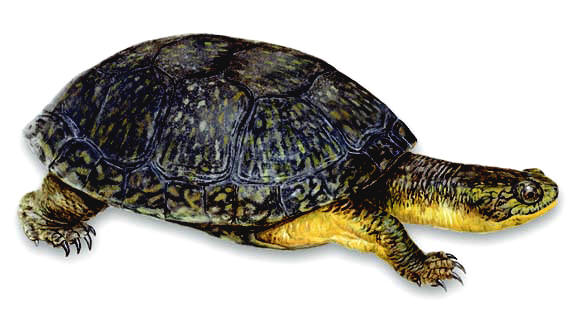
Gilead Power Corporation's Ostrander Point Wind Project was the first one to be rejected on appeal by the Ontario Environmental Review Tribunal (ERT).  This was not due to human health issues, or worries about the effects of nine proposed turbines on migratory birds, though the project is located near an Important Bird Area (IBA).  No.  It was due to the presence on site of a population of humble Blanding's Turtles:

...the problem lay with a road network that would have been built in order to construct and maintain [the project].  This network would have been smack dab in the middle of the turtle's habitat; the beasts would have been forced to cross these roads on multiple occasions and at multiple points during their life cycle.  Since the network would have been publicly accessible, more ATV and other traffic would have been drawn to the area.  Furthermore, available mitigation measures were judged ineffective.  Nobody obeys road signs, for example.  And culverts where the turtles might safely cross under the road depend on the species having crossing "hot spots"--preferred road crossing points--where these devices might be installed.  Unfortunately, Blanding's Turtles do not use their habitat in the appropriate manner.

Gilead Power has appealed the rejection, making what I thought were some rather weak arguments. However, now they are proposing some extra measures to protect the turtles:

On January 20 the developer will seek to present new evidence to the appeal hearing. Specifically it will ask the court to consider a plan to erect a series of gates securing access to the road network it wants to build on Crown land at Ostrander Point.

“Restricting public access to the access roads would also provide enhanced protection for wildlife, including species at risk, from traffic mortality,” wrote Mike Lord to the Ontario Ministry of Resources (MNR) in August.

In September a MNR official agreed it would issue a lease of the Crown land to the developer to enable it to build the fence, pending the approval of the project. The MNR also sought a “Project Access and Control Plan” for the access roads. That plan calls for six double swing gates to be erected at key points, one at the entrance and at five other locations where preexisting trails intersect with the proposed access road. The gates would be locked from May 1 to October 15. Gilead staff will monitor and enforce access restrictions.

I'm not sure this will do the trick.  It sounds from a cursory read that off-road vehicles coming from local trails will be able to avoid the gates and abuse the project's access roads, although Gilead Power staff will be monitoring the area.  Important to note, however, that the danger is not from the turbines themselves but from local Oiks and their ATVs.

Monday, August 05, 2013

Appeals Of The Ostrander Point Windfarm Decision

There are three of them, which you can read about through the link.  The one that most concerns me is:

The appeal by MOE could not likely have occurred without approval from the Ontario government of which it is a part, specifically of the Cabinet which includes the Premier. It is unlikely that any Ministry or Minister would act on its or his/her own initiative without such approval on a matter of major delicacy and importance. The only implications to be drawn seem to be that the Premier’s efforts to distance herself from her predecessor and her assurances of more cordial relations and cooperation with rural municipalities on Green Energy Act matters are spent.

The author of this is a wind-farm opponent, and so hardly unbiased.  However, the MOE action is troubling; the Environmental Review Tribunal's reasoning and ultimate decision relating to Ostrander Point seemed pretty clear.  The standard package of mitigations designed to protect endangered species in the presence of a wind-farm was not adequate for the Blanding's turtle population near Ostrander Point.   On the other hand, the most clearly stated MOE counter-argument (assuming this is an accurate account of it) strikes me as bizarre:

 The proponents now say that the serious and irreversible harm test applies province wide and that it was the responsibility of PECFN [Prince Edward County Field Naturalists] to prove that the project would cause serious and irreversible harm to the turtle population province wide.

If the province's stock of endangered turtles is parceled out into discrete sub-populations, of which only one or two would be effected by a particular development, how could you stop any development?

In any case, I am trying to get hold of the legal documents behind the appeal.  We shall see what sense they make.

Friday, July 05, 2013

Saved By The Shell! Ostrander Point Wind Project Cancelled Due To Presence Of Endangered Turtle!!!!

The  Ostander Point Wind Project has been revoked because:

... the roads systems and construction [necessary for the project] would cause serious and irreversible harm to the Blanding’s Turtle and that the proposed mitigation plans were insufficient to protect the endangered species.

The full ruling is below.  Its worth a read-through (which I've done!).  Project opponents brought six arguments to the tribunal: 1) the project would cause human health issues, 2) the project would endanger migratory birds passing through the Ostrander Point IBA (Important bird Area), 3) the project would endanger bats living near or migrating through through the area,  4) the project would encroach on the breeding grounds of the local Monarch Butterfly population, 5) the project would endanger plant life in the local alvar , and 6) the project would endanger the local population of Blanding's Turtle.

Below the document are excerpts in regards to each of these issues:


Human Health
And:

Effect On Migratory Birds

I think the appellants felt that this was their strongest card.   After all Ontario Environmental Commissioner Gord Miller had argued against allowing wind-farms in important bird areas.  However, after much testimony and counter-testimony, the tribunal saw things differently:
And:

I'm not particularly surprised by this aspect of the ruling.  Most ornithologists, when asked to rank causes behind the decline in NA bird populations over the past several decades, wouldn't even put wind farms on their top ten list.  In fact, if people really wanted to make a difference re saving endangered bird species they'd kill their pet cat (in particular if its an outdoor cat); each of these vicious little bastards kill about as many birds per year as an average turbine, and they can't heat your house.  

Bats

This was the most interesting aspect of the decision for me.  As noted, "there is very little scientific research available on the impact of wind turbines on bats, partly because bats are extremely difficult to study." Some highlights of the testimony included:

And this, with respect to mitigating the effect of turbines:
In the end, the Tribunal concluded:

Monarch Butterflies

The project was to be located near Prince Edward Point National Wildlife Area, which is a International Monarch Butterfly Reserves.  Concerns were raised that it would negatively impact Monarch populations.  The Tribunal didn't buy it:
Similarly with the local plant life: the project would not cause “serious and irreversible harm”.  I'm not going to excerpt that bit, because lets face it plants are boring.

And I'll don't think I'll excerpt the bits about Blanding's Turtle either, even though these considerations finally put a stop to the project.  Its important to note, however, that the presence of turbines was not itself an issue.   Rather, the problem lay with a road network that would have been built in order to construct and maintain them.  This network would have been smack dab in the middle of the turtle's habitat; the beasts would have been forced to cross these roads on multiple occasions and at multiple points during their life cycle.  Since the network would have been publicly accessible, more ATV and other traffic would have been drawn to the area.  Furthermore, available mitigation measures were judged ineffective.  Nobody obeys road signs, for example.  And culverts where the turtles might safely cross under the road depend on the species having crossing "hot spots"--preferred road crossing points--where these devices might be installed.  Unfortunately, Blanding's Turtles do not use their habitat in the appropriate manner.

So there you have it.  A win for the anti-windfarm faction, but really more bad than good news in the ruling.  Claims re the negative health effects of turbines continue to gain no traction.  The recent study by Nissenbaum, which garnered so much media attention, is referenced a whole one time in the ruling.  In practical terms it has clearly had no effect on the debate.  Furthermore, the judgement's position re IBA's suggests that turbines can probably operate safely within protected areas.  That's a pretty important point going forward.

Saturday, December 29, 2012

More On Birds, Bats,Turtles, And Wind Farms

From Today's London Free Press:

As Conservative Senator Bob Runciman pointed out in a news release, that approval [for a complex at Ostrander Point], like so many others, was granted against local wishes. The project also “threatens migratory birds and bats and it makes no sense from an energy standpoint,” the senator said.

Runciman points out that another wind farm in a designated important bird area, Wolfe Island, has a kill rate for birds and bats “that is seven times the industry average in Canada, primarily because it is located in the wrong spot.”

The actual number counted between July and December of 2009 at Wolfe Island was 602 birds, which may or may not be higher than the industry standard.  Nevertheless, ornithologists tend to be unmoved by such figures.  To keep things in perspective (from a flap.org news release):

An Estimated 14,000 Migratory Birds Die Every Day in Toronto

[...]

“One to ten birds die per building, per year in Toronto alone,” says Michael Mesure, Executive Director of FLAP. “Currently, over 940,000 registered buildings in this region pose this threat.”

Here's a collection of just a few of them:

Now, in regards to the project at Ostrander Point: you can see what Gilead Power (the project developer) has to do to ameliorate the effect of their turbine farm here.  Furthermore, I've written earlier about the set of requirements that Grand Valley Wind Farms Inc. was made to follow to build nine wind turbines in the Township of East Luther Grand Valley, and the situation with Ostrander Point strikes me as similar:

The restrictions seem quite elaborate, and involve "more than mitigation measures or “replacing” what is lost", for example providing and maintaining....habitat on nearby [project developer] owned land and timing construction activity to avoid the...nesting season. 

I would note additionally that some anti-wind folk appear to believe that the turbines at Ostrander Point will have a negative impact on the local population of Blanding's Turtle.  Of course they won't; it's the roads that must be built to service them that are the problem.  Turtles like roads; they like to sun themselves on them, to cross them, and to lay their eggs in the loose gravel alongside of them.  Hence the speed bumps and signage noted in the regs, and the limitations on when construction and road maintenance can take place.