Showing posts with label The Griffen. Show all posts

Monday, July 01, 2013

Your Daily Nazi: McCorkell Collection Update

This clip from CBC brings the latest, in particular that the University of Ottawa, which got some of McCorkell's artifacts after he moved East from Saskatchewan , is willing to let the collection be sold off to private collectors:

As for me, I was most interested in the few glimpses of McCorkell's collection that the clip offers.  My favorite piece is this:


Maybe its a bit of pottery.  I'm not sure.  But the beast carved on its surface is pretty clearly a Griffin, one of my favorite of the mythical creatures.  And that's chiefly because:

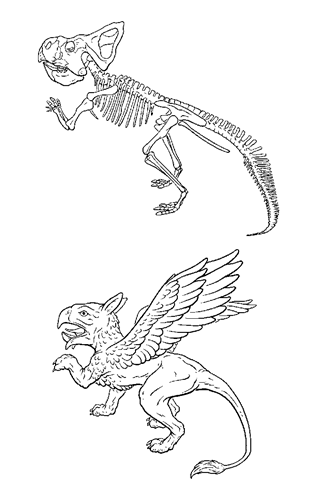
Much of the griffin folklore originated from the deserts of central Asia, specifically in an area of alluvial gold deposits in a thousand-mile corridor dividing land masses that are now China, Mongolia and Kazakhstan. Mayor's research led her to consult paleontologists to see what kinds of fossils were common to the area.

The Gobi, Turfan and Dzungarian deserts contain some of the world's richest fossil beds, and many fossils appear on the surface because of the windswept nature of the region. Fossils of the plant-eating Protoceratops are the most commonly found dinosaur fossils in the Gobi desert.

Protoceratops was a creature six or seven feet long, with four legs, claws, and a scary beak that looked like a huge lobster claw....  [A]ncient people may have dug up skeletons of the Protoceratops, a probable theory considering that American tourists who visited the Gobi Desert in 1992 uncovered a complete, standing dinosaur skeleton trapped in the sand. It would only take a small imaginative step for ancient prospectors, making similar finds, to think that living griffins existed and guarded their nests like protective mother birds in the same standing position. 

You can see the two creatures compared here, for example.

Not much more to add here other than to repeat myself: it would be a pity if this collection was sold off to fund a gang of white supremacists.

As to the U of O's decision, I suspect McCorkell's collection is good but not essential.  Rare but not that rare.  I've seen ancient coins, for example, turn up in flea markets in Arizona.  One fellow told me the piece he was hawking for $30 U.S. showed a constellation of stars on the face that were not visible with the naked eye, suggesting that the ancients had had contact with alien races.  I told him I was just off the plane, not the boat.

PS.  U of O labels the griffin thusly: Panel from painted terracotta revetment frieze with griffin from Düver (Turkey) 550 B.C.

Monday, July 09, 2007

The Fetid Beast And Other Cryptozoological Mysteries


A nifty story in today' N.Y.Times about the search for the Mapinguary, a fabled and possibly non-existent Monster of the Amazon Jungle. The name, which when translated means "the fetid beast", refers to the "animal's strong, extremely disagreeable odor". Cryptozoological types would like to think the animal is a living representative of the Megatherium, a very, very large (elephant sized) type of sloth that died out thousands of years ago. More likely, however:

the legend of the mapinguary is based on human contact with the last of the ground sloths,” thousands of years ago, said David Oren, a former director of research at the Goeldi Institute in Belém, at the mouth of the Amazon River. “We know that extinct species can survive as legends for hundreds of years. But whether such an animal still exists or not is another question, one we can’t answer yet.”

Another possibility is that the legend is based on native misinterpretations of the fossilized remains of Megatherium. This would certainly not the first time such a thing has happened. For example, Adrienne Mayor has argued famously that the legend of The Griffin is based on the attempt by ancient Scythian nomads to make sense of the vast Protoceratops bone beds of the Gobi Desert.


More recently she has argued that West Coast native Indian legends of the Kiowa water monster are based on Thalattosuchia, an ancient, ten foot long marine crocodile whose fossilised remains have been found in the area.
Mayor's work is fascinating from a cryptozoological perspective. The world is rife with legends of "sea serpents', which are often used as evidence for the veracity of modern sightings. But in some cases these legends may be based on interaction with fossil skeletons rather than actual animals.