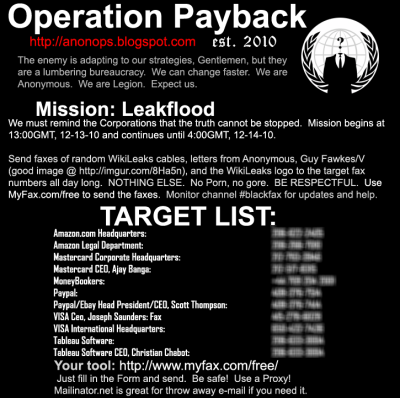
A handy tool.
Showing posts with label Wikileaks. Show all posts
Sunday, May 01, 2011
Monday, December 20, 2010
WikiLeaks Piece In The Mark
My first post on Wilikleaks has appeared in The Mark, where it will be read and commented upon at the highest levels. I predict that CSIS steps in and screws around so my debit card won't work.
And, incidentally, anyone that tells you there's no news in those cables hasn't been paying attention.
Tuesday, December 14, 2010
To the Rescue!
I, MICHAEL MOORE, care of Finers Stephens Innocent, 179 Great Portland Street, London, W1W 5LS make this statement and say as follows:
1. I am a filmmaker, author and political commentator and I produce as my exhibit [MM/1] evidence of my identity in the form of a photocopy of my passport/driving licence. I am an American citizen.
2. I am aware of the various allegations Julian Assange faces in Sweden. I am willing to act as security for Julian in the sum of twenty thousand dollars USD$20,000.
No joke. Read the whole thing through the link.
1. I am a filmmaker, author and political commentator and I produce as my exhibit [MM/1] evidence of my identity in the form of a photocopy of my passport/driving licence. I am an American citizen.
2. I am aware of the various allegations Julian Assange faces in Sweden. I am willing to act as security for Julian in the sum of twenty thousand dollars USD$20,000.
No joke. Read the whole thing through the link.
Monday, December 13, 2010
Wikileaks Exposes Tiny Bit Of Evil: UK/USA Ethnic Cleansing
One common complaint re the wikileaks cables is that, for all the sound and fury, they haven't revealed much new information. I think that this claim has become more difficult to sustaing over the past couple of weeks. For example, have you ever heard of the Chagos Islands and their indigenous inhabitants, the Chagossians?
The Chagos Islands are a series of atolls that float peaceably enough in the middle of the Indian Ocean, part of the British Indian Ocean Territory. Back in the 1960s and '70s, the U.S. decided it needed a naval base in the area, on an island without a "population problem", so hey presto! the Brits made a deal with (ie took bribes from) the Yanks and deported several thousand mostly African Chagossians off to Mauritius, where they still live today as their legal attempts to arrange a return to their homeland gradually founder. Meanwhile, in April of this year, the U.K. government declared the islands a "marine environmental reserve ".
And here's where wikileaks comes in:
The establishment by Britain of the world's largest marine environmental reserve around the Chagos Islands in the Indian Ocean was just a pretext to prevent the return of the forcibly deported islanders.
And behind that cunning move was the determination of the British government to reaffirm its strategic commitments to the United States, which operates one of its largest overseas air, naval and Marines bases on Diego Garcia island in the Chagos chain.
And diplomatic messages from the U.S. embassy in London published by WikiLeaks last week show British officials calculated backing for the move by the environmental lobby would conclusively outweigh supporters of the rights of the Chagos islanders, known as Chagossians.
Well, that would frost your ass, wouldn't it? The UK and US enlist environmentalists in their efforts to keep the Islands ethnically cleansed, so the Americans can keep operating their naval base in the middle of a whole whack of endangered species, including giant tortoises.
The government of Marutius sure wasn't happy when they got there hands on that leaked cable:
Mauritius' Foreign Affairs Minister Arvin Boolell was quoted in local newspapers last week as saying the classified document confirmed his government's belief that the protected area was in fact a smoke-screen.
"We are going to formally convene the British High Commissioner next week ... to listen to his explanations," Boolell was quoted as saying.
For me, this one cable justifies the release of the lot, as it reveals a tiny instance of government sponsored evil that would otherwise go unseen. Maybe once it was the job of journalists to do this kind of thing, but since they abandoned that role long ago, someone has to step in and fill the void.
Oh, and there's that other cable about how the Vatican was "offended" when Ireland's government decided to investigate the propensity of Catholic priests to rape young boys. That one too was revealing.
The Chagos Islands are a series of atolls that float peaceably enough in the middle of the Indian Ocean, part of the British Indian Ocean Territory. Back in the 1960s and '70s, the U.S. decided it needed a naval base in the area, on an island without a "population problem", so hey presto! the Brits made a deal with (ie took bribes from) the Yanks and deported several thousand mostly African Chagossians off to Mauritius, where they still live today as their legal attempts to arrange a return to their homeland gradually founder. Meanwhile, in April of this year, the U.K. government declared the islands a "marine environmental reserve ".
And here's where wikileaks comes in:
The establishment by Britain of the world's largest marine environmental reserve around the Chagos Islands in the Indian Ocean was just a pretext to prevent the return of the forcibly deported islanders.
And behind that cunning move was the determination of the British government to reaffirm its strategic commitments to the United States, which operates one of its largest overseas air, naval and Marines bases on Diego Garcia island in the Chagos chain.
And diplomatic messages from the U.S. embassy in London published by WikiLeaks last week show British officials calculated backing for the move by the environmental lobby would conclusively outweigh supporters of the rights of the Chagos islanders, known as Chagossians.
Well, that would frost your ass, wouldn't it? The UK and US enlist environmentalists in their efforts to keep the Islands ethnically cleansed, so the Americans can keep operating their naval base in the middle of a whole whack of endangered species, including giant tortoises.
The government of Marutius sure wasn't happy when they got there hands on that leaked cable:
Mauritius' Foreign Affairs Minister Arvin Boolell was quoted in local newspapers last week as saying the classified document confirmed his government's belief that the protected area was in fact a smoke-screen.
"We are going to formally convene the British High Commissioner next week ... to listen to his explanations," Boolell was quoted as saying.
For me, this one cable justifies the release of the lot, as it reveals a tiny instance of government sponsored evil that would otherwise go unseen. Maybe once it was the job of journalists to do this kind of thing, but since they abandoned that role long ago, someone has to step in and fill the void.
Oh, and there's that other cable about how the Vatican was "offended" when Ireland's government decided to investigate the propensity of Catholic priests to rape young boys. That one too was revealing.
Sunday, December 12, 2010
WikiLeaks Hackivists Draw Blood?
The online shopping site Amazon was briefly offline this evening in the UK, Germany, Italy and France and an unknown number of other countries, possibly after a denial of service attack launched by Anonymous, a loose group sympathetic to – but unconnected with – WikiLeaks.
Go script-kiddies.
Looks like they got MasterCard too, so they are learning fast.
Just keep your butts out of jail, kids. They like 'em young in there.
Wednesday, December 08, 2010
Wikileaks As Brand
[John] Young suggested that WikiLeaks was effectively a commercial organisation competing in an open market, alongside others who sell sensitive information, such as former spies and the media. He claimed it glamorised the significance of the information it had to generate cash from donations. "The transparency market has been monetised," he said. "And it has caught on." WikiLeaks's financial ambitions have been strong. On an internal mailing list in January 2007 for the founders of WikiLeaks.org, the group stated: "It is our goal to raise pledges of $5m by July."
And each "brand" would differ from its competitors by offering a competing "ethical protocol" for the release of whistle-blowers' documents. For example, a number of potential rivals have criticized wikileaks for
...concentrating on publishing material about the US while other information was neglected.
Assuming that this is the case (although even if it is, t'was not always so), other outlets might specialise in uncovering secrets from other regimes. And thus the free market for secrets will be served.
PS. John Young's website Cryptome is here. His issues with Julian Assange appear to be many and varied, I must say.
PPS. "Ethical Protocol" turns out to be a real word. Weird: I thought I'd just made it up.
And each "brand" would differ from its competitors by offering a competing "ethical protocol" for the release of whistle-blowers' documents. For example, a number of potential rivals have criticized wikileaks for
...concentrating on publishing material about the US while other information was neglected.
Assuming that this is the case (although even if it is, t'was not always so), other outlets might specialise in uncovering secrets from other regimes. And thus the free market for secrets will be served.
PS. John Young's website Cryptome is here. His issues with Julian Assange appear to be many and varied, I must say.
PPS. "Ethical Protocol" turns out to be a real word. Weird: I thought I'd just made it up.
Tuesday, December 07, 2010
Wikileaks 2010, CRU 2009, Napster 2000
I remember the day ten years ago a neighbor's daughter whispered to me about this new piece of software called Napster that would let you download music files for free. I tried it, and in late 2000 shifted to high-speed cable, along with hundreds of thousands of other Internet users. Around that same time, the American recording industry declared war on these Peer-to-Peer services, and users were compared to everything from criminals to communists, not always inaccurately.
These days, P2P is all a bit old hat; while many of the 1st and 2nd generation services disappeared under the entertainment industry's legal onslaught, they were immediately replaced by nimbler successors. Now everyone under 50 uses them, and nobody I know personally has bought a CD in the last 5 years.
Of course, the technology involved is very different, but the story of Napster 2001 has many parallels to the story of Wikileaks 2010, and the lessons gleaned from that earlier episode apply today.
And the first and most obvious lesson is: morality of the thing aside, you can't kill it. For the last several days, the world has watched our leaders play whack-a-mole with the wikileaks website; the only result has been hundreds of mirror-sites set up to host the leaked diplomatic cables should the main site be pushed off-line. In addition, word of wikileaks competitors has begun to emerge. Furthermore, if all of these were successfully driven from the Net, a simple zipped file stuffed with secrets could be released onto the various interlocking P2P networks noted above. And beneath all of these, in the very depths of the cyberspace, Ian Clarke's FreeNet--which was originally designed to facilitate exactly this kind of whistle-blowing--lies in wait as teh host of last resort.
The second important lesson is: if you can't kill it, you shouldn't bother trying. Most of those who have criticized the various calls for Julian Assange's death have done so on the grounds that these incitements are criminal/immoral. Less note has been made of the fact that creating a martyr for the hacker community--either in the form of Mr. Assange or his organization--would be profoundly stupid. The death (shutdown) of Napster did nothing but unleash a storm of technical innovation all bent on thwarting the authority that ordered this very same shutdown--bent on thwarting the record companies, in other words. And here we are ten years later with file-trading still flourishing and the music industry, by its own admission, in terminal decline.
And here's the thing: during its last days of existence, Napster executives were in furious negotiations with the major labels, and their business case could be summed up as: Après moi, le déluge. With us, you will get something; after us, the file-sharing world will fragment, and you will be unable to negotiate with the pieces. I believe that the international community is facing exactly the same situation with regards to wikileaks. It would be a much wiser course to deal--as in negotiate with--wikileaks, or perhaps one of its emergent rivals, towards an ethical protocol for the leaking of future documents. Otherwise, instead of files appearing with names redacted, we will have pure document dumps onto obscure Mongolian servers with no concern at all for whose interests might be damaged.
The international community ought to negotiate its own surrender, in other words, rather than face a rout.
Finally, the ongoing wiki-leaks saga bears a number of resemblances to the CRU Hack of 2009, in which private emails written by U.K. and American climate scientists were stolen from the University of East Anglia, and uploaded onto a server in Russia. The content of these emails proved embarrassing for the scientists responsible, but ultimately trivial. More importantly, in the aftermath of the event a number of arguments against this kind of disclosure were made that prefigured the kind we are hearing today. Scientists, it was argued then, will literally produce less science if their every utterance is held up for scrutiny. Diplomats, it is argued now, will be unable to do their jobs if some of the advise they give is not allowed to remain secret. Today, as in 2009, the public response to such arguments has been the equivalent of a disinterested shrug. Millions of people read the stolen emails; millions more are even now reading the leaked cables. We are headed, it appears, towards an age of "enforced transparency", wherein anyone that knows anything will be forced to disclose what they know.
The Internet has already made it clear that humans have an insatiable desire for music and pornography. Now add to these a third thing: secrets.
These days, P2P is all a bit old hat; while many of the 1st and 2nd generation services disappeared under the entertainment industry's legal onslaught, they were immediately replaced by nimbler successors. Now everyone under 50 uses them, and nobody I know personally has bought a CD in the last 5 years.
Of course, the technology involved is very different, but the story of Napster 2001 has many parallels to the story of Wikileaks 2010, and the lessons gleaned from that earlier episode apply today.
And the first and most obvious lesson is: morality of the thing aside, you can't kill it. For the last several days, the world has watched our leaders play whack-a-mole with the wikileaks website; the only result has been hundreds of mirror-sites set up to host the leaked diplomatic cables should the main site be pushed off-line. In addition, word of wikileaks competitors has begun to emerge. Furthermore, if all of these were successfully driven from the Net, a simple zipped file stuffed with secrets could be released onto the various interlocking P2P networks noted above. And beneath all of these, in the very depths of the cyberspace, Ian Clarke's FreeNet--which was originally designed to facilitate exactly this kind of whistle-blowing--lies in wait as teh host of last resort.
The second important lesson is: if you can't kill it, you shouldn't bother trying. Most of those who have criticized the various calls for Julian Assange's death have done so on the grounds that these incitements are criminal/immoral. Less note has been made of the fact that creating a martyr for the hacker community--either in the form of Mr. Assange or his organization--would be profoundly stupid. The death (shutdown) of Napster did nothing but unleash a storm of technical innovation all bent on thwarting the authority that ordered this very same shutdown--bent on thwarting the record companies, in other words. And here we are ten years later with file-trading still flourishing and the music industry, by its own admission, in terminal decline.
And here's the thing: during its last days of existence, Napster executives were in furious negotiations with the major labels, and their business case could be summed up as: Après moi, le déluge. With us, you will get something; after us, the file-sharing world will fragment, and you will be unable to negotiate with the pieces. I believe that the international community is facing exactly the same situation with regards to wikileaks. It would be a much wiser course to deal--as in negotiate with--wikileaks, or perhaps one of its emergent rivals, towards an ethical protocol for the leaking of future documents. Otherwise, instead of files appearing with names redacted, we will have pure document dumps onto obscure Mongolian servers with no concern at all for whose interests might be damaged.
The international community ought to negotiate its own surrender, in other words, rather than face a rout.
Finally, the ongoing wiki-leaks saga bears a number of resemblances to the CRU Hack of 2009, in which private emails written by U.K. and American climate scientists were stolen from the University of East Anglia, and uploaded onto a server in Russia. The content of these emails proved embarrassing for the scientists responsible, but ultimately trivial. More importantly, in the aftermath of the event a number of arguments against this kind of disclosure were made that prefigured the kind we are hearing today. Scientists, it was argued then, will literally produce less science if their every utterance is held up for scrutiny. Diplomats, it is argued now, will be unable to do their jobs if some of the advise they give is not allowed to remain secret. Today, as in 2009, the public response to such arguments has been the equivalent of a disinterested shrug. Millions of people read the stolen emails; millions more are even now reading the leaked cables. We are headed, it appears, towards an age of "enforced transparency", wherein anyone that knows anything will be forced to disclose what they know.
The Internet has already made it clear that humans have an insatiable desire for music and pornography. Now add to these a third thing: secrets.
Subscribe to:
Posts (Atom)