Saturday morning, I was hanging around the parking lot of the Canlan Ice Complex on Markham Road, near Steeles Avenue (in TO), waiting for the wife to finish her skating class, and I noticed a gray bird forcibly depriving a robin of its worm. The bird was about the same size as the robin, but longer and thinner, and with a lengthy tail bordered by white feathers. Furthermore, when the beast flew off with its stolen worm, I noticed a prominent white bar running across the underside of the wings.
As this was something I hadn't seen before, I spent a half hour watching the little beast, and discovered that a pair of them were working on a nest in a stand of trees between the ice-rink and Markham Road.
When I drove away on Saturday morning, I had no idea what species I had been watching. My best guess was a Shrike, or maybe a Grey Jay, but nothing really matched up with what I was seeing in my Peterson's guide, so the mystery remained.
...until Monday when I stumbled across
this article in the TO Star:
They evoke Spanish moss and magnolias — their crazy, copycat arias providing a signature song of the south.
The mockingbird, after all, is the state bird of Arkansas, Florida, Mississippi, Tennessee and Texas.
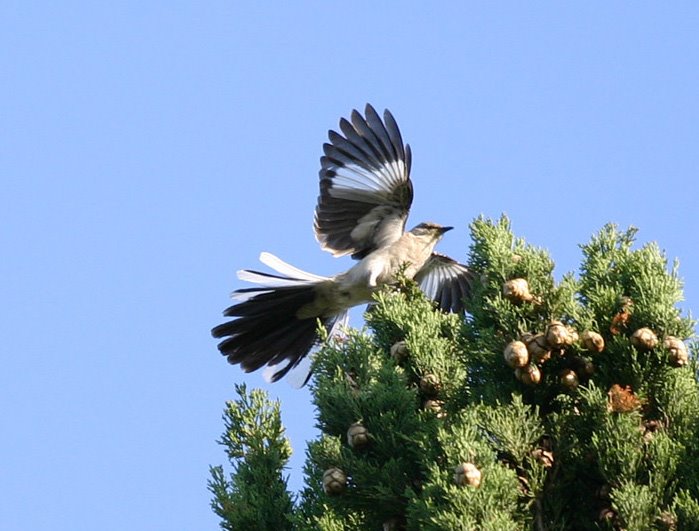
So what were these three plump young Dixie chicks doing stuffed into a nest near Eglinton Ave. W. and Black Creek Dr. in west Toronto last week?Now, the article only showed a picture of the three chicks, but here are a couple of pictures of adults from the web. The first shows the wing-pattern, and the white tail-feathers:
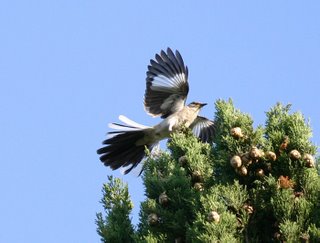
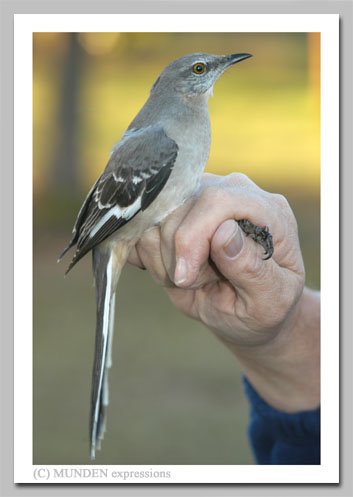
The next one is a close-up:
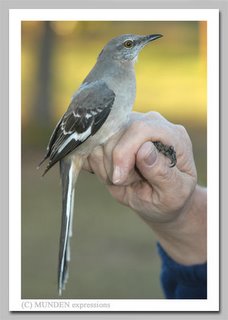
So, bingo! I had been watching a pair of nesting Mockingbirds, or
Mimus polyglottos!
Now, why have these animals have been advancing North from their
traditional range? Answer:
...global warming [...is...] being pegged as a prime suspect. "Absolutely," Royal Ontario Museum ornithologist Mark Peck says of the climate-change theory. "And there has been some modelling to that effect, which talks about birds moving northward and what we expect to find."The idea is this. As the planet warms, Southern birds will move North. Meanwhile, Northern Birds move further North, and Arctic birds will get squeezed and die out.
So when people ask you for empirical evidence for Global Warming, it's easy to show them, because it is absolutely everywhere, in the way the animals in the fields and trees in your own town or city have changed over the years.
For example, in the GTA, it isn't just how Mockingbirds have come North, its the way Jays and Crows have
almost disappeared since the arrival of West Nile Fever (and the local Cardinal population seems to have exploded to fill the ecological niche that has been vacated).
Of course, I think GW skeptics have moved on, by scientific necessity, from denying the bare facts of the matter, to at least trying to account for them, usually via theories which have already been discredited (like blaming Global Warming on
Solar Variation).
But that is the subject of another post.
As for my little grey buddies up on Markham, I'm gone for a couple of weeks and then I'll take my new digicam up there and see if I can't get a few pictures.
Unwelcome visitors though they are, they are quite striking, and have a very pretty
song.